If needed, download pdf reader software by clicking here.
Purchase
Note 1
How to maintain continual pro-symptom focus
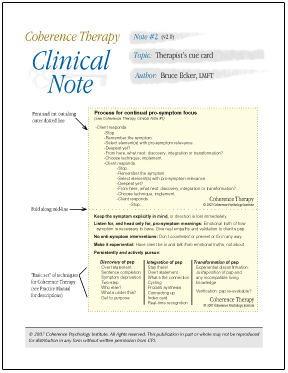
Note 2
Therapist's cue card
Note 3
Verbalization of emotional truths
Note 4
Coherence Therapy for low self-worth: How to orient the client
Note 5
Functional & Functionless Symptoms in Coherence Therapy
Note 6
Overview of Coherence Therapy and Its Use Of Memory Reconsolidation
A solid introduction to Coherence Therapy's methodology and conceptual framework, including its built-in use of memory reconsolidation for achieving permanent, transformational change. A case example illustrates the concepts and methodology.
(PLEASE NOTE: This is the same Overview as is included since November 2016 in each viewer's manual in the Coherence Therapy Video Demonstration and Training Series.)
Note 7
Guidelines for Creating Juxtaposition Experiences
This Clinical Note provides a thorough map for carrying out the final phase of Coherence Therapy, the transformation phase. In this phase, the client's symptom-generating emotional learning or schema is profoundly unlearned and dissolved by juxtaposition experiences that induce the memory reconsolidation process. A key task facing the therapist is guiding the client to find and experience contrary knowledge that will be used in the juxtaposition to disconfirm, unlearn and nullify the knowings in the target schema. The various possible sources of that contrary knowing are mapped out in this Note, along with techniques for utilizing them. The Note ends with a list of published case examples illustrating each of the sources of contrary knowledge. If you have been waiting for the Manual of Juxtaposition Experiences, this is its initial incarnation in highly condensed form, to be filled out later with numerous case examples to create that manual.
(PLEASE NOTE: The material in Note 7 is included in the Coherence Therapy Practice Manual.)
Table of Contents
- The emotional truth of the symptom
- Symptom coherence
- Methodology of coherence therapy
- Strategy of coherence therapy
- Shortest path of discovery: How to utilize symptom coherence
- Therapist's orientation in discovery: Essential features
- Techniques of discovery
- Training exercises
- Core ordering: how unconscious constructs are organized
- Symptoms with and without functions
- The four forms of symptom coherence
- Underlying emotional truth of depression: 3 types
- Case examples
Integration Experiences: Inhabiting Emotional Truth(Methodology Phase 2)
- How integration achieves true accessing
- How integration achieves the pivot into agency
- In-session techniques of integration
- Between-session tasks of integration
- Optimal final form of integration
(Methodology Phase 3)
- Transformation concepts and methodology
- Techniques for finding contrary knowledge
- Guiding juxtaposition experiences
- Verifying transformational change
- Index of case examples of the sources of contrary knowing
Dispelling Client Resistance in Coherence Therapy
- Conscious resistance: Techniques
- Unconscious resistance: Techniques
- Resistance to discovery experiences
- Resistance to integration experiences
- Resistance to transformation experiences
- Underlying emotional truth of anxiety/panic/phobia: 4 types
- Case examples
- Symptom coherence in low self-worth: Unconscious purposes requiring negative self-regard
- Strategy and procedure for low self-worth
- Case examples
- Pattern of unconscious constructs in low self-worth
Use of Client-Therapist Relationship in Coherence Therapy
- Four therapeutic effects of the client's relational experience of the therapist
- When to focus the work on client transference
- Techniques for utilizing transference
- How to maintain continual pro-symptom focus moment to moment
- How the therapist thinks, listens, selects what to respond to, and selects how to respond
- 12 pages systematically covering the full range of therapists' learning issues and troubleshooting needs
What Limits the Rate of Change in Coherence Therapy?
Corroborating Research
Glossary